AI university guidance tools for schools: compare by task
Compare BridgeU/Bree, MaiaLearning AI, Lyra and an improved school form by task, public evidence, counselor oversight and school effort.

A polished AI demonstration can answer many questions without answering the school's most important one: what work would this improve? Before comparing university guidance tools, choose the task you need to support, then ask each provider to demonstrate it under comparable conditions. Examine the student preparation, the quality of information and the counselor's ability to question the result.
Lyra prepared this guide. The provider descriptions below come from public pages checked on 21 October 2026, not comparative hands-on testing. It compares selected options: BridgeU/Bree, MaiaLearning AI, Lyra and an improved existing school form. This is a task-based shortlist guide, not an exhaustive market review or a league table of performance. An official feature page establishes what a provider says its product does, not how well it will work in your school.
Start with the gap in the current process
“We need an AI tool” leaves too much undefined. Perhaps students arrive with vague reasons for their choices. Perhaps the team needs reliable course research, better application organization or a clearer handoff between tutors and counselors. Those are different purchasing questions.
Write one sentence describing what happens now and what you want to become easier. For example: “Students complete our preparation form, but their answers rarely explain why a course interests them. We want a more useful starting point for individual meetings.” Keep the existing process in the comparison. A clearer prompt or better timetable may address part of the problem without a new platform.
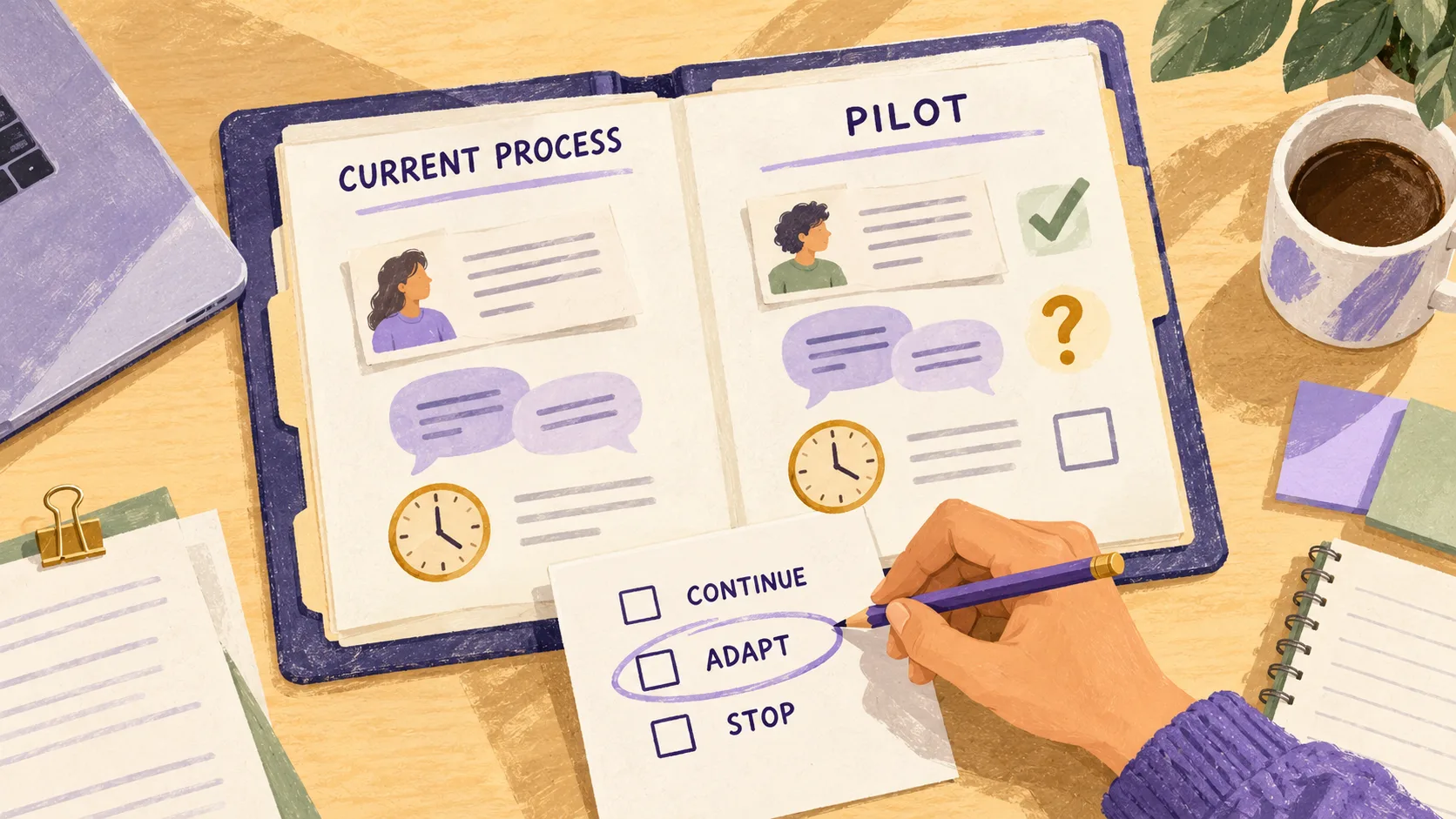
The published pilot checklist helps distinguish participation from useful preparation once you have a focused evaluation question.
Compare the task each option actually supports
Official pages give a more useful starting point than an undifferentiated list of “AI tools.” The matrix below is a Lyra-authored synthesis, checked on 21 October 2026. The school questions are our suggested tests, not observed shortcomings.
| Option and official evidence | Publicly described task | What to demonstrate, including school effort |
|---|---|---|
| BridgeU/Bree help page and Bree overview | University research, application questions, essay ideas and platform help | Demo-student access; source checking, correction and counselor handoff. |
| MaiaLearning AI | College search, MaiaChances, essay review and teacher-letter assistance | Destination coverage, estimate limits, educator review and staff effort. |
| Lyra: documented core workflow | Conversational reflection, student insights and university/programme exploration | Student correction, a usable counselor question and current access. |
| Existing school form, with a clearer prompt | Experience, reason and course question without a new platform | Same scenario and meeting; track tutor explanation and reading effort. |
Bree's official help page says it is student-only, unavailable through advisor accounts; counselors can explore it through a demo student account. Include that access route in the demonstration rather than assume staff see the same screen.
MaiaLearning's provider page explicitly describes AI capabilities; treating it as only a general planning platform would be misleading. Its admissions estimates are a provider feature claim, not verified probabilities for your students. Likewise, Bree's description of deadline assistance is not evidence that a particular answer is current. Neither provider's public page settles your contractual access, reliability or international coverage.
Unifrog remains a relevant wider-platform alternative for exploration and progression. This review did not establish a specific official AI-feature page for an equivalent assistant. Ask for the current feature evidence if AI is part of its proposal; that gap is not a claim that Unifrog lacks AI.
Where each may fit: investigate Bree when the question concerns student research within BridgeU; MaiaLearning when the proposed search, writing or admissions-estimate tasks match the school's need; Lyra when the gap is the student's reasons before a counselor conversation. Improve the existing form first when the missing piece may be a clearer prompt or handoff. These are task-based starting judgments from documented scope, not independent recommendations based on testing.
Give each provider the same small task
Prepare a synthetic student scenario rather than uploading a real student's personal information to an unapproved tool. For example: a student enjoys designing community activities, has several possible course interests and is unsure how to investigate them.
Ask the provider to show what the student contributes, what the tool produces, and what a counselor can use. Then introduce a complication: the student disagrees with the interpretation, the information lacks a source, or a practical condition changes.
Watch the response to that complication. A fluent first answer is only part of the workflow. You need to understand how uncertainty, correction and follow-up are handled, and what work shifts to staff.
School task we are comparing:
What our current process does well:
Synthetic scenario used with every provider:
What the student had to contribute:
Output and permissions demonstrated for student and counselor:
An error, ambiguity or disagreement we would test:
Observed response if tested; otherwise explicitly not yet observed:
Staff work, access arrangements and support needed:
Unverified items requiring a written answer:
Reason to continue, adapt the test or stop:
Here is a completed illustrative record, not an observation of any named provider:
Task/current process: Improve vague preparation for individual meetings; our current form already captures the basic facts.
Demonstration: A synthetic student enjoys coordinating events but cannot explain the course interest. We ask them to disagree with the first interpretation.
Mixed result: The sample output gives a specific experience to discuss, but the student-style response still needs prompting to explain the interpretation. Staff correction effort is not yet clear.
Decision: Continue only to a small, school-approved evaluation of that preparation task. Ask for the correction workflow and staff responsibilities first; do not infer purchasing value from the polished report alone.
The completed record gives the next provider conversation a purpose. Apply the same complication to each shortlisted option, and retain the current form as a comparison.
Treat admissions information as a separate check
Where a tool supplies course requirements, deadlines, costs or scholarships, ask it to identify the official source and relevant application cycle. Open the source. Check whether the answer matches the exact course, qualification and applicant category, and what happens when the source is missing or contradictory.
A useful research suggestion still needs an official-source check before a consequential application decision. Ask the demonstrator to show that handoff, including what happens when information is missing.
You can evaluate reflective preparation and admissions information separately. A strong result on one does not establish performance on the other. This distinction also makes a provider conversation fairer: you are judging the work you actually intend to use.
Examine counselor oversight and school effort
Ask where the student's own words end and an interpretation begins. Can a counselor find the original context? How does the student challenge something that sounds wrong? Can staff identify what remains unknown without reconstructing the whole interaction?
Then walk through the ordinary school work: introduction, access, reminders, review, correction and the next meeting. Record who does each part and what support the demonstration assumed. A provider-led session may show the product well without showing the effort needed during a normal school week.
Obtain current written information about permissions, data handling, contractual terms, accessibility, support and pricing through the school's procurement process. Mark unanswered questions as unanswered; a marketing description is not a security or legal assessment.
Make a conditional recommendation
Consider a hypothetical comparison in which one tool produces a detailed report but requires extensive staff interpretation, while another gives less polished output that students can readily explain. Neither observation settles the whole purchasing decision. Ask which better supports the chosen task, under the support conditions your school can maintain.
Your conclusion could be to test one provider with a limited group, improve the preparation prompt first, or pause until a material question is answered. Explain the strongest reason the preferred option might not be suitable. That makes the recommendation easier for colleagues to examine.
Put Lyra through the same questions
For Lyra, test the link between conversational reflection, the student's profile and possible university/programme directions. Ask what the student contributed, which explanation a counselor can examine, and how the student would challenge a direction that does not appeal. Then identify the course question they would investigate. Keep that task distinct from an application-administration demonstration: success at reflective preparation would not establish that a tool meets a different school need.
Compare the value of that preparation with the work your school already does. The Counselor's Desk perspective on student clarity explains the educational need behind that approach. To examine the actual workflow for your school, request a counselor demo.
Common questions from counselors
Which AI university guidance tool is best?
There is no defensible universal winner from the evidence in this guide. Choose a task, use comparable demonstrations and examine requirements, staff effort and unresolved questions for your school.
Are the provider descriptions independently verified features?
They are verified summaries of what the official pages say on the review date, not hands-on tests or independent proof of reliability. Confirm current access, destination coverage and contractual scope in a demonstration.
Should we compare AI with our existing guidance process?
Yes. Include the existing process and a reasonable improvement to it among the alternatives. Otherwise, you may attribute the benefit of better instructions or additional staff time to the tool.
Can we use real student records in a demonstration?
Use a synthetic scenario until your school has approved the relevant access and data arrangements. A commercial demonstration alone does not authorize sharing student information.