Start a reflection cohort with a clear counselor handoff
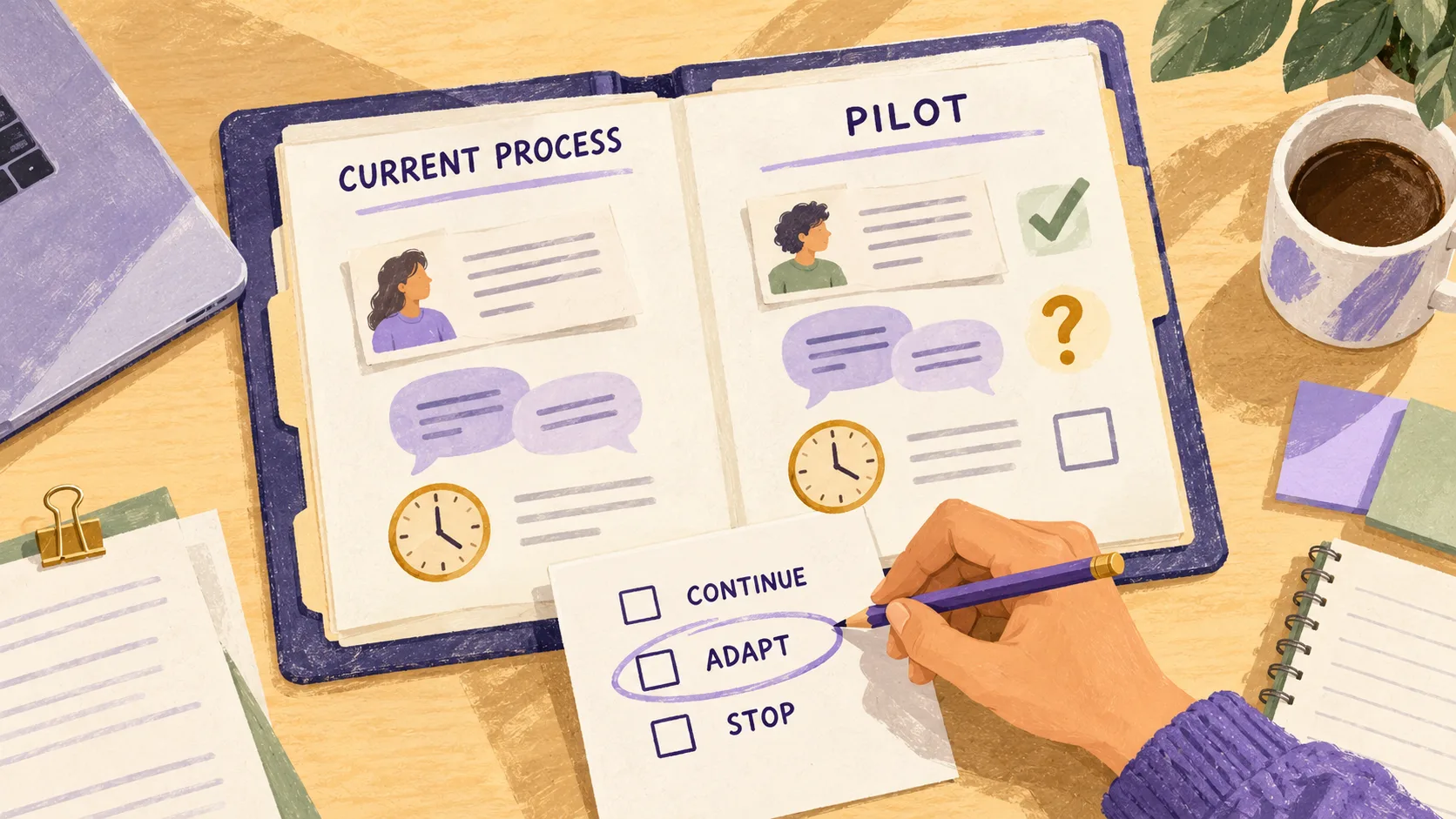
A completed six-student school-week handoff: invitation, preparation, counselor review, meetings, backup ownership and recovery.

The invitation has gone out, students have started reflecting, and the counselor is waiting for useful preparation. Then someone asks who will read the responses and when students will discuss them. If that was never agreed, the school has launched an activity without finishing the guidance workflow. Define the handoff before the cohort begins: purpose, owner, next conversation and a route for students who need help.
This guide helps international-school counselors coordinate a small group through an existing school process. The aim is a clear next step for each student, not a larger pile of completed outputs.
Start with the completed Monday–Friday handoff, then adapt the staff coordination record. Size the group to the preparation the responsible counselor can actually review, not the number the platform can invite.
Start with the conversation the preparation serves
Choose a task the team can describe. “Help students bring an experience and a course question to their next meeting” is more actionable than “increase engagement.” State what happens now and what the reflection is meant to add.
Use the group the school can support. A cohort should be small enough for the responsible staff to introduce the task, respond to difficulty and use the preparation. Do not select a number merely because a platform can invite that many students.
The EEF implementation guidance is useful for thinking about everyday school context. The handoff record below is a suggested planning resource, not an EEF instrument or evidence that a particular reflection tool improves outcomes.
Name the owner of each part
| Part of the workflow | What staff need to agree |
|---|---|
| Introduction | Who explains the purpose and models a useful response? |
| Access | Who checks the actual route and resolves a problem? |
| Student questions | Where can a student ask about instructions or sharing? |
| Counselor review | Who reads the relevant preparation, and when? |
| Next conversation | How does the student know what happens after reflecting? |
| Follow-up | Who checks that the next action or unresolved question has an owner? |
A role can be held by the same person, but it still needs to be explicit. “The guidance team” may sound sufficient until a tutor assumes the counselor has reviewed the work and the counselor assumes the tutor is organizing the appointments.
If a colleague covers a task temporarily, include what happens when they are absent. The student should not need to reconstruct the school's internal responsibilities to receive a response.
Give students an invitation with a next step
An invitation should explain what students will do, why it matters and who will use the preparation. Confirm the actual access instructions and timing for the chosen resource before sending it.
A school might adapt this wording:
“Before our next guidance conversation, choose one experience you want to understand better and one question about your next step. We will use that preparation to decide what to investigate together. You can be uncertain. If access or a question becomes difficult, use the school contact route below.”
Fill in the real contact and next meeting arrangement. Do not promise a response deadline or appointment that nobody has agreed to provide. Explain information sharing through the school's approved process and offer an appropriate route for personal concerns.
Copy the cohort handoff record
Class/year group and guidance task covered:
What happens in our current process:
What preparation is meant to add:

Who introduces the activity and when:
Actual access route checked:
Who handles access or instruction questions:
Who reviews the preparation and when:
What students are told about sharing:
How a student raises a private concern:

Next counselor conversation or review point:
What the student should bring:
What happens if preparation is unfinished:
Who records and owns the next action:
What we will review before inviting another group:
Keep this with the school's existing coordination notes. It should clarify a handoff, not create a parallel student record or new administrative system.
Run one complete school week before expanding
Here is a wholly illustrative six-student school run, using existing tutor time and guidance appointments. The school has already approved the chosen resource, sharing and access. The named roles below are assignments for this example, not assumed product automation.
Monday: kickoff and invitation. The tutor models one experience/question, explains sharing and gives the checked access route. The counselor confirms six Thursday/Friday appointments and review slots. An access contact and backup IT colleague are named.
Tuesday: protected preparation. Students use the allocated school period or an accessible alternative. The tutor clarifies the prompt; access problems go to the contact, then the backup if unresolved. An unfinished student can bring one experience/question instead.
Wednesday: first review. The counselor reads three available profiles/briefs in an allocated 30-minute slot and chooses one question each. Students keep their own notes. A missing output is marked for a conversation, not counted as reviewed.
Thursday: second review and first meetings. The counselor reviews the other three preparations in a second 30-minute slot. The first three students attend existing 15-minute appointments. If cover is needed, use an authorized backup counselor whose access/responsibility the school has confirmed, or rearrange explicitly.
Friday: remaining meetings and recovery. The other three attend, including an unfinished student who begins with an ordinary experience. The counselor records next actions in the existing school record. Tutor and counselor review unresolved cases and effort before new invitations.
The scheduling arithmetic is 60 minutes of preparation review, separate from 90 minutes of existing appointments: six preparations in two 30-minute review slots and six 15-minute meetings. Tutor introduction, access support and coordination time are additional, not silently included in that total. Those are proposed local allocations, not claims about how fast a product generates outputs or how long every student needs. If the preparation or review takes longer, reduce the group or change the timetable rather than silently add staff work.
Walk the recovery through too: a Tuesday access failure has an access owner and backup; a Wednesday missing profile still has a Thursday/Friday conversation; an absent counselor has either an authorized substitute or an explicitly rearranged appointment. The student does not lose their next step because the output or adult is unavailable.
For a student ready to investigate a course question, record one source check and the next conversation in the same school handoff.
Distinguish events the team might otherwise combine
An invitation sent, an activity started, a report available and a counselor conversation are different events. Confirm what any product status actually means. Avoid treating a familiar dashboard label as evidence that a member of staff has read the output or that the student benefited.
The pilot evaluation checklist helps keep participation, usefulness and school effort separate. A cohort can have strong participation but still produce broad answers or an unmanageable review burden.
Ask whether a student can explain something specific, whether the counselor can use it, and what work made that possible. Those observations help decide what to change before expanding.
Fit Lyra's school view into the handoff
Lyra's school-facing workflow brings student progress and available profiles into the counselor's view. Use that visibility to locate the preparation that needs attention, then connect it with the school responsibilities in the record. A tutor can explain the task while the appropriately authorized counselor reads the profile; the school decides the actual access arrangement.
Before launch, ask the team to demonstrate the invitation route and what each relevant progress state means in your school's current setup. Agree which school colleague responds to a problem and when the student will discuss their question. This is a school handoff built around available product behavior, not a promise that a dashboard manages the whole process.
Use the Counselor's Desk perspective on thinking time when discussing review effort with colleagues. To work through a specific preparation and handoff question with Lyra, request a counselor demo.
Close the loop before adding another group
Ask staff where the process became unclear and students what they understood would happen next. Resolve missing ownership, unexplained statuses or inaccessible preparation before treating the first run as a template.
Expansion should follow the school's ability to use the preparation. A clear next conversation for a smaller group is a stronger starting point than an impressive invitation count with nobody available to follow through.
Common questions from counselors
How large should the first cohort be?
Choose a group the available staff can introduce, support and review. This guide does not prescribe a universal size. The relevant constraint is the school's ability to complete the intended workflow.
Is a generated report the end of the handoff?
It establishes that an output is available, not that the counselor has reviewed it or the student has discussed it. Agree the next conversation and its owner separately.
What happens to students who do not finish?
Investigate the barrier and offer an appropriate next step. Keep their guidance route open; do not treat incomplete preparation as a reason for their question to lose an owner.
Can we assume the platform sends reminders and manages appointments?
Confirm the actual released features and the school's arrangement. A general reflection workflow does not establish a particular reminder, booking or reporting capability.