How to propose a university guidance tool to school leadership
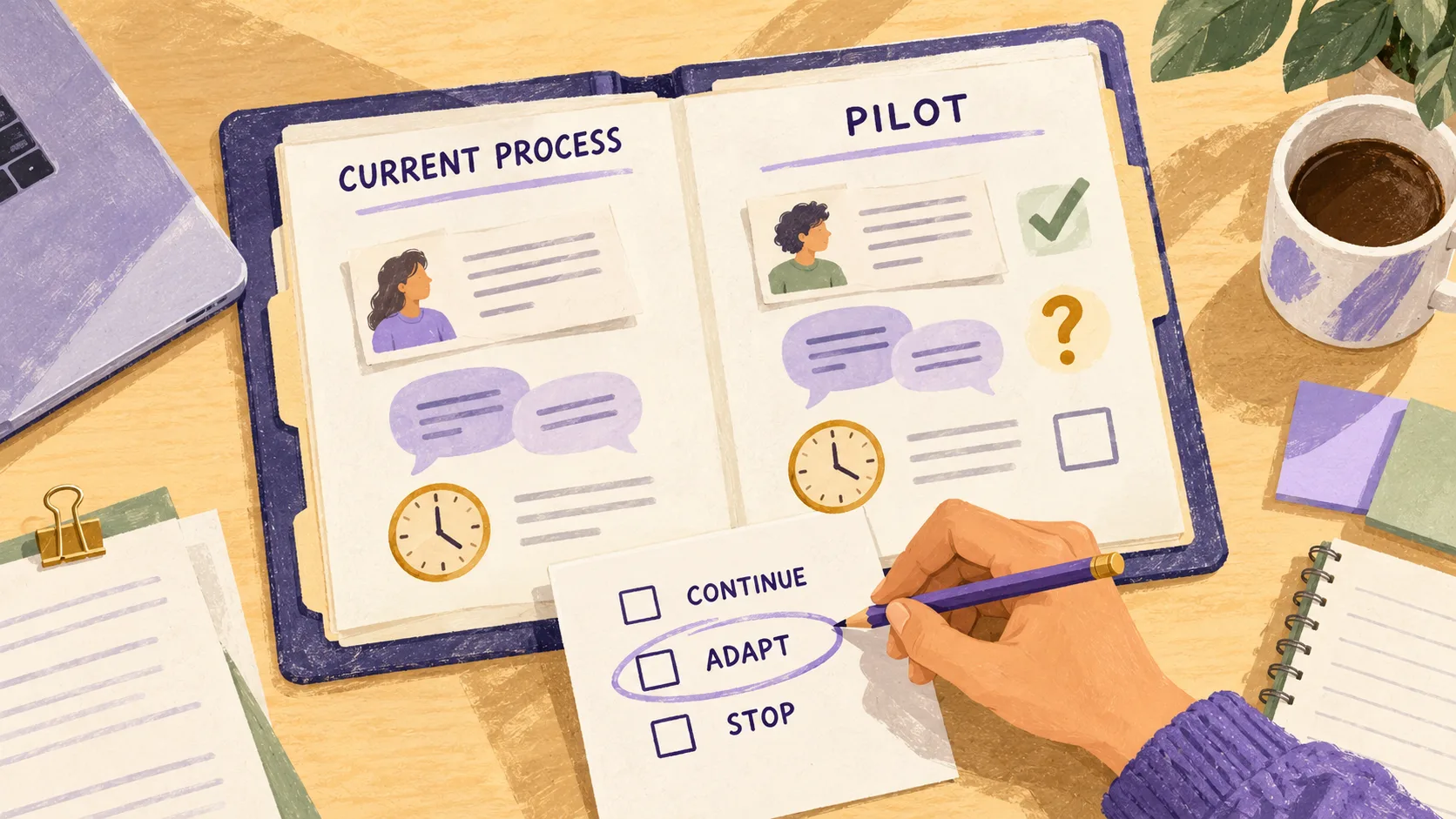
A completed one-page illustrative approval memo for a limited guidance-tool evaluation, with baseline, staff effort and data/IT conditions.

You have seen a tool that could help, but leadership needs more than a convincing demonstration. A useful university-guidance proposal explains the school task, how the current process works, what the tool might add and what a limited evaluation would need. Ask for a decision colleagues can examine, with the staff work and unanswered questions visible.
For international-school counselors, a short proposal can do that well. It should make the choice clearer, not disguise uncertainty beneath a longer feature list.
Need a document to take forward? Copy the completed one-page approval memo. Its request is bounded: approve preparation and due diligence for an evaluation, subject to school data/IT approval, while comparing it with an improved existing process. It does not authorize a purchase or student upload.
Describe the school problem before naming the product
Start with an observation from the school's own process. For example: “Students complete our preparation form, but counselors still spend the opening part of meetings establishing why a course interests them.” Use only evidence the school actually has; do not turn an impression into a percentage or a measured time saving.
Explain why the problem matters and who experiences it. A counselor's difficulty using general responses is different from an access problem or missing application administration. A tool may address one without improving the others.
Then state the task you want to evaluate: “Can different preparation give students something more specific to explain at the next meeting, within staff time we can sustain?” That is a proposal question leadership can discuss.
Include the current process as an alternative
A comparison should contain the school's existing approach and at least one reasonable improvement to it. Perhaps a clearer prompt, better tutor introduction or more visible meeting handoff would address part of the need.
This does not weaken the case for a tool. It explains what you are asking the school to buy or test beyond a change it could make anyway. If extra staff time or provider-led support is central to the proposal, include it so leadership does not mistake the demonstration conditions for normal provision.
The EEF implementation guidance emphasizes the context in which an approach becomes everyday school practice. Use that perspective to examine the work around the product, rather than cite it as proof that the product succeeds.
Show the workflow on one page
| Stage | What the proposal should make clear |
|---|---|
| Student preparation | What students contribute, through which approved route |
| Staff review | Who reads the output, what they need to find and when |
| Guidance conversation | What the preparation is meant to help the counselor ask |
| Next action | How the student leaves with an investigation or decision they understand |
| Support and correction | Who handles access, misunderstanding or an interpretation the student disputes |
Name the actual school roles. A workflow that depends on an unnamed colleague finding spare time is not yet an implementation plan.
For counselors who teach or coordinate the DP, include that context. Leadership needs to understand which work is new, which existing task it could replace and what still has to happen alongside it.
Make the commercial and data questions inspectable
Request current written pricing, contract scope, support arrangements and any material limits. Separate confirmed terms from estimates and optional services. Record the proposal's relevant period and currency rather than mixing a short trial with an assumed annual cost.
Use the school's procurement and information-governance process for permissions, data handling, retention, accessibility and other relevant questions. An enthusiastic demonstration is not a completed review of those matters.
Where AI is involved, ask how staff and students can question an output and how consequential information is sourced. UNESCO's guidance on generative AI in education provides a broader human-centered perspective; it is not an endorsement or certification of a particular provider.
Propose a limited learning plan
Choose a question the school can observe in its normal workflow. For meeting preparation, ask whether students can explain more specific reasons and whether counselors can use that detail. Record the effort required, including introduction, support, reminders and review.
The published counselor pilot checklist provides a practical evaluation resource. Logins and completion can describe participation, but they cannot establish the usefulness of preparation or a confirmed educational outcome.
Agree who will review the observations and what would lead to continue, adapt or stop. If the proposal depends on an unanswered product or school question, name it as a condition before the evaluation begins.
A forwardable proposal template
Decision requested:

School task and current process:
Observed problem and the evidence we actually have:
Students and staff affected:

Options considered, including improving our current process:
Why this tool is worth evaluating for the stated task:
Student preparation → staff review → conversation → next action:
New staff work, owner and realistic support:

Current commercial terms and unresolved questions:
Required school procurement/data/access review:
Limited evaluation group and period:
What useful preparation would look like:
How we will compare with the existing process:
Evidence that would make us continue, adapt or stop:
Review owner and date:
Strongest reason not to proceed yet:
Replace the fields with the school's actual evidence before forwarding. Keep a proposal about what you intend to learn distinct from an account of results already achieved.
A completed one-page approval memo
The memo below is entirely illustrative. Its observations, numbers, timing and roles are invented to show what a completed request looks like, not a Lyra result, a real school's account or approved commercial terms. Copy it as a short memo, replace the facts with your school's evidence and attach the required terms rather than the whole article.
ILLUSTRATIVE APPROVAL MEMO
To: Head of Secondary | From: University counselor
Request: Approve due diligence for a six-student, one-week Lyra evaluation before existing appointments. No student access until school data/IT approval; no purchase or expansion authorized.
Need/baseline: In this fictional school, four of six preparation forms gave a course name without a reason. Compare Lyra with an improved form asking for one experience, reason and question.
Why Lyra: A reflective profile may provide a specific counselor question. Demonstrate synthetic student input → profile interpretation → next question. This is the proposition to investigate.
Scope/effort: One tutor-group subset. Tutor: 15-minute introduction and 10-minute support slot. Counselor: two 30-minute reviews plus six existing 15-minute appointments. IT lead: provisionally 30 minutes; confirm sufficiency before starting.
Measures: Can the student explain a reason and the counselor use it? Record prompting, correction and staff effort for both approaches. This small test cannot prove impact.
Conditions: Written scope/price, permissions, retention/deletion, AI processing, accessibility and support answers need school approval. Access owner: IT lead; backup: authorized school colleague.
Review: Counselor reports to Head of Secondary on the next school day after the final appointment. Continue only to a further evaluation if preparation is useful and effort sustainable; adapt unclear prompts; pause for unresolved data/terms or workload.
Decision now: Approve this bounded plan and name the data/IT reviewer.
The distinction in the final line matters: leadership can approve a defined next step without approving unresolved commercial or data arrangements. Replace role labels with named owners in the real school memo; there is no assumed automatic approval, booking or report-sharing feature.
Build a Lyra proposal from the preparation you can show
For a Lyra proposal, show one synthetic student's guided reflection and the resulting profile of their interests, values and influences. Ask the counselor to choose the question that preparation would support, then explain what the student would investigate after the meeting. Leadership can examine that concrete chain rather than accept a broad promise of better guidance.
Have the Lyra team demonstrate the current student and counselor views and provide the applicable terms. Keep any unresolved release-dependent feature out of the business case until confirmed. The Counselor's Desk perspective on thinking time can help frame review effort alongside student preparation.
To investigate Lyra against a specific school task, request a counselor demo. Bring the actual workflow and the question the proposal needs to answer. That makes the conversation useful before either side discusses a wider rollout.
Common questions from counselors
How long should the proposal be?
Use enough detail for leadership to understand the decision, effort, conditions and review. A concise main brief with supporting evidence can be clearer than a long product description.
Should I include projected time savings?
Only with a clear evidence basis and assumptions. A benefit you want to investigate should be described as an evaluation question, not a promised percentage saving.
Is a successful pilot enough to approve a school-wide purchase?
Examine what was observed, whose experience it covers and which support conditions made it possible. A limited result may justify another question rather than immediate expansion.
Can we skip the current-process comparison if we already like the tool?
Including it helps distinguish the tool's contribution from clearer instructions, extra tutor time or other changes. It gives leadership a more defensible basis for the decision.